Showing posts with label Electronics. Show all posts

Saturday, August 24, 2019

Review: Bond Bridge Connects Radio-based Home Electronics to Your Smart Home

Apple Smart Home
I try to make my home as smart as possible, and I have Alexa devices and smart lights in just about every room, but one set of appliances has been left out. Until now. The folks at Bond sent me their Bond Bridge ($99) to review. It bridges the gap, no pun intended, between Alexa-type voice assistants and traditional RF-controlled devices like ceiling fans and electric fireplaces. In the future, it should work with air conditioners, window shades and similar devices.

Related: Your Apple Smart Home: Innovative Tech for Every Room in the House
Apple Smart Home
The unit itself has a compact, unobtrusive design, not unlike an Amazon Echo Dot, and a really long (about 10 feet) microUSB cable, so you can place it anywhere you need to. This is important because one Bond Bridge could work for multiple devices as long as it's placed within range. I set up a Bond Bridge in my youngest daughter's bedroom and it was able to control the ceiling fan for her and the one in my other daughter's bedroom. It's not cheap, but if you can spread out the cost over multiple RF devices, it becomes quite reasonable.
Apple Smart Home

Pros

  • Works with RF-based ceiling fans and fireplaces now and more devices in the future
  • Integrates with Alexa using Alexa skill
  • Compact, unobtrusive design
  • Long microUSB cable and A/C adapter included
  • One Bond Bridge can interface with multiple RF devices

Cons

  • Expensive but only one may be needed

Final Verdict

The Bond Bridge brings traditional RF devices into the age of the smart home.
Master your iPhone in one minute a day: Sign up here to get our FREE Tip of the Day delivered right to your inbox.


* This article was originally published here

Wednesday, July 24, 2019

Samsung Electronics Partners with e-sport Game Shows to Showcase High-Performing SSD Solutions

Samsung Electronics has become an official sponsor of the World Cyber Games (WCG), known widely in the industry as the ‘Olympics’ for e-sports.

This year, WCG returned to the international stage after a six-year hiatus, making it a highly anticipated event for e-sports fans all around the world. Qualification matches have been held online by region all over the world since March, and those who advanced were invited to the WCG 2019 Grand Final, hosted from July 18-21 in Xian, China.

On top of its official sponsorship of WCG 2019, Samsung operated a 595 square meter Samsung Exhibition at the event for visitors to explore.

Samsung Partners with e-support
The 2019 World Cyber Games captivates audiences in Xian, China

Samsung Electronics SSD will also be participating in the games show China Joy in August, as well as the Tokyo Game Show this September, two games shows that make up half of the top four global game industry events. At these two events, Samsung Electronics SSD will also set up exhibition booths for visitors to enjoy a series of events, video streams and pro-gamer competition matches.

Samsung is pursuing these partnerships with global gaming shows due to the suitability of their Solid State Drives (SSDs) for the gaming industry. Take a look at the video below, produced by Samsung to showcase the industry-leading performance and speed of its SSDs, to see main character Bike overcome competitors and other obstacles by collecting Samsung SSD products.


Compared to traditional HDDs, Samsung’s SATA SSDs boost performance by up to 4 times, extract files 3 times faster and copy photos 10 times faster. For instance, it takes only 31 seconds for SDDs to extract a 4.7GB movie, while this same process takes over 3 times as long – 96 seconds – using HDDs. Accordingly, users playing high-spec games are increasingly adopting SSDs. Samsung’s V-NAND flash-based SSD (860 PRO/EVO/QVO) provides players with a fully immersive game-playing environment thanks to the overall boost it gives to PC performance. The benefits to this SSD include high-speed game loading times, low latency and seamless in-game responsiveness, even when multitasking.

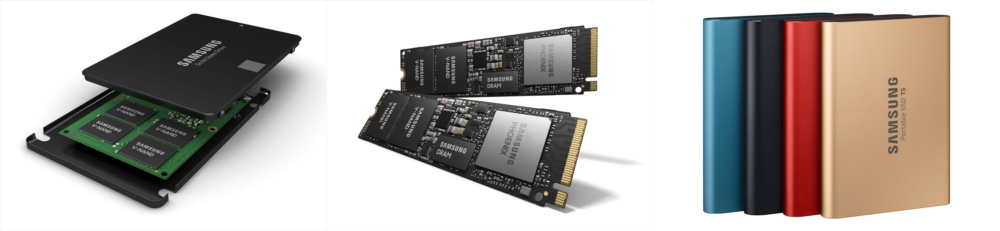
The Samsung 970 EVO Plus is an SSD designed for games that support 4K or Direct X12, which call on PCs to handle the download of large files along with increased disk input/output operations. The Samsung NVMe SSD 970 EVO Plus can significantly increase the speed of such demanding games; according to Samsung’s internal test results, game loading is reduced between 7 to 37% when using an NWMe SSD compared to SATA drives.

The Samsung Portable SSD T5 can be applied to a gaming console, offering not only a fast loading speed but also the increase of a console’s storage space up to 2TB. Samsung internal testing showed that when using the Portable SSD T5, users enjoyed a significantly faster game loading speed compared to when using an external HDD.

Samsung Electronics Partners with e-sport
(From left to right) 860EVO, 970 EVO Plus, Potable SSD T5


* This article was originally published here

Sunday, July 14, 2019

Samsung Electronics and SK Telecom Advance in Bringing Korea Closer to 5G Standalone Commercialization

Samsung Electronics and SK Telecom (NYSE: SKM) today announced the successful completion of Korea’s first interoperability assessment between 5G Standalone (SA) Core and other commercial network systems over a 5G network. This successful result brings the two companies one step closer to 5G SA commercialization.

The 5G SA Core, jointly developed by Samsung Electronics and SK Telecom, not only supports technologies including network slicing and function modularization based on 3GPP standards, but also offers additional functions that operators have been using since LTE, include billing, subscriber management and operational convenience system. The interoperability assessment is the final stage for verifying the validity of 5G SA data transmission, signifying that the SA system is ready to be launched for commercial service.

Both companies implemented several cutting-edge technologies in the 5G SA Core that has been used for the interoperability. The technologies include Data Parallel Processing technology that performs QoS and transmission control simultaneously; Data Acceleration technology that classifies and distributes similar traffic types; and Path Optimization technology that automatically delivers data traffic to Mobile Edge Computing (MEC) platform.

“The fundamental structure of 5G SA is built on a completely new configuration, successfully delivering the most optimized 5G service to customers and enterprises across numerous industries,” said Jaeho Jeon, Executive Vice President and Head of R&D, Networks Business at Samsung Electronics. “Maintaining Korea’s leadership in network innovations through continuous investments in next-generation technologies is important to Samsung and SK Telecom, and the companies will continue to collaborate on developing and commercializing 5G SA.”

“Along with the initial phase of NSA rollout, we have been continuously focusing on researching and developing the SA technology in order to provide customers a differentiated service quality with innovative products, which will be launched in the first half of next year,” said Park Jin-hyo, Chief Technology Officer and Head of ICT R&D Center at SK Telecom. “By strengthening bilateral collaboration with Samsung, SK Telecom will drive and lead highly innovative 5G technologies and solutions.”

Once 5G SA is commercialized, data processing efficient will be improved by threefold, allowing efficient control for supporting massive data traffic. Moreover, 5G SA system is highly optimized for emerging next generation services such as Autonomous driving, Smart Factory, Smart Farm, and AR/VR.

For the past five years, the two companies have been collaborating on LTE and 5G development, which ultimately led to this successful 5G SA Core interoperability test. Some of other accomplishments include the commercialization of Virtualized LTE Core and Packet Optimization system; and they have completed the development of 3GPP Rel. 15 based SA Core in July last year, and successfully launched 5G NSA commercial service in April this year.


About SK Telecom
SK Telecom is the largest mobile operator in Korea with nearly 50 percent of the market share. As the pioneer of all generations of mobile networks, the company has launched the fifth generation (5G) network on December 1, 2018. The company is not only leading innovations in the field of mobile network, but is also creating unprecedented value in areas such as media, security and commerce. In the Fourth Industrial Revolution, SK Telecom will inspire the world, building a future beyond expectations. Building on its strength in mobile services, the company is also creating unprecedented value in diverse ICT-related markets including media, security and commerce. For more information, please contact skt_press@sk.com or sktelecom@bm.com


* This article was originally published here

Saturday, July 13, 2019

Samsung Electronics Launches “Make the Wave” Music Campaign at FINA 2019

make the Wave

Samsung Electronics, an official sponsor of the 18th FINA World Championships Gwangju 2019, has launched the “Make the Wave” campaign to encourage athletes and also inspire their fans by connecting them through inspiring music, based on its brand philosophy, “Do What You Can’t”.

Samsung Electronics appointed Simone Manuel as the ambassador for this year’s campaign, to encourage sports fans from all over the world to share music through social media. Simone Manuel won a gold medal and set an Olympic record in the women’s 100-meter freestyle at the 2016 Summer Olympics in Rio de Janeiro. As Samsung Electronics’ ambassador for the event, she will share a message of encouragement and discuss pushing boundaries without losing hope amid difficult circumstances, as well as talk about the songs and the music that inspire her and help boost her performance.

As part of the campaign, special events are planned for aspiring swimmers in Gwangju city. Students will be provided with a chance to be escorts for the water polo finals. They will also meet Kim Se-jin, an accomplished swimmer better known as the “robotic leg swimmer,” who was a member of South Korea’s national disabled swimming team.

“This campaign is designed to spread the heat of the competition with a variety of marketing activities, to share the stories of swimmers who are challenging themselves in working toward their dreams, and to cheer on one another through music, powered by our brand philosophy of ‘Do What You Can’t,’” said Younghee Lee, Global CMO at Samsung Electronics. “I hope that everyone will enjoy the events throughout our ‘Make the Wave’ campaign.”

“I am glad to be able to share my stories and songs by participating in the ‘Make the Wave’ campaign, which corresponds with my can-do spirit. I hope all swimmers will leave the competition without any regrets and that sports fans will cheer on the athletes loudly,” said Simone Manuel.

Samsung Electronics has set up a 255-square-meter experience zone in the athlete village, where athletes will be able to interact with other swimmers through uniform exchange, birthday parties and a Korean name calligraphy event. Additionally, there will be opportunities to test out Samsung’s latest products such as the Galaxy S10 series, AKG N700 headphones, ‘The Frame’ 4K TV, and Samsung Notebook 7.

Samsung Electronics, which has sponsored FINA since 2015, has been supporting the events with various products. For this year’s events in Gwangju, in addition to the official sponsorship, Samsung is providing 1,996 refrigerators for the athlete village and the stadiums where the competitions will take place.

The 18th FINA World Championships Gwangju 2019, which will kick off on July 12, is one of the world’s top-five mega sports events, with competitions in six events – swimming, diving, high diving, water polo, artistic swimming and open water swimming. About 7,266 aquatic sports athletes, officials, media, and International Swimming Federation officials from 193 countries have registered, an all-time high. More than 12,000 participants are expected to gather in Gwangju for the events, including the World Masters Swimming Competition starting on August 5.

Any sports fan can participate in the digital event on the official website of Samsung Electronics to share their songs and cheer for the athletes. Those interested in the event can visit the official page (www.samsung.com/fina2019), select the music they have been inspired by when facing new challenges, and share it on their personal social media with their own album cover. This event will be held from July 9 to August 18 during which 20 AKG N700 headphones and 41 Galaxy Buds will be given away through a lucky draw.


* This article was originally published here

Friday, July 5, 2019

Samsung Electronics Announces Earnings Guidance for 2Q 2019

Samsung Electronics announced its earnings guidance for the second quarter of 2019.

  • Consolidated Sales: Approximately 56 trillion Korean won
  • Consolidated Operating Profit: Approximately 6.5 trillion Korean won

The above estimates are based on K-IFRS. Please note that Korean disclosure regulations do not allow earnings estimates to be offered as a range. To comply with such regulations, the above figures represent the median of the estimate ranges provided below.

  • Sales: 55 ~ 57 trillion Korean won
  • Operating Profit: 6.4 ~ 6.6 trillion Korean won

Note : The estimates include a one-time gain related to the display business.


  2019 1Q and 2018 2Q consolidated figures based on K-IFRS are as follows
(in trillion won)
2019.1Q 2018.2Q
Sales
52.39
58.48
Operating profit 6.23
14.87


* This article was originally published here

Tuesday, July 2, 2019

Samsung Electronics Introduces A High-Speed, Low-Power NPU Solution for AI Deep Learning

Deep learning algorithms are a core element of artificial intelligence (AI) as they are the processes by which a computer is able to think and learn like a human being does. A Neural Processing Unit (NPU) is a processor that is optimized for deep learning algorithm computation, designed to efficiently process thousands of these computations simultaneously.

Samsung Electronics last month announced its goal to strengthen its leadership in the global system semiconductor industry by 2030 through expanding its proprietary NPU technology development. The company recently delivered an update to this goal at the conference on Computer Vision and Pattern Recognition (CVPR), one of the top academic conferences in computer vision fields.

This update is the company’s development of its On-Device AI lightweight algorithm, introduced at CVPR with a paper titled “Learning to Quantize Deep Networks by Optimizing Quantization Intervals With Task Loss”. On-Device AI technologies directly compute and process data from within the device itself. Over 4 times lighter and 8 times faster than existing algorithms, Samsung’s latest algorithm solution is dramatically improved from previous solutions and has been evaluated to be key to solving potential issues for low-power, high-speed computations.


Streamlining the Deep Learning Process

Samsung Advanced Institute of Technology (SAIT) has announced that they have successfully developed On-Device AI lightweight technology that performs computations 8 times faster than the existing 32-bit deep learning data for servers. By adjusting the data into groups of under 4 bits while maintaining accurate data recognition, this method of deep learning algorithm processing is simultaneously much faster and much more energy efficient than existing solutions.


Samsung’s new On-Device AI processing technology determines the intervals of the significant data that influence overall deep learning performance through ‘learning’. This ‘Quantization1 Interval Learning (QIL)’ retains data accuracy by re-organizing the data to be presented in bits smaller than their existing size. SAIT ran experiments that successfully demonstrated how the quantization of an in-server deep learning algorithm in 32 bit intervals provided higher accuracy than other existing solutions when computed into levels of less than 4 bits.

When the data of a deep learning computation is presented in bit groups lower than 4 bits, computations of ‘and’ and ‘or’ are allowed, on top of the simpler arithmetic calculations of addition and multiplication. This means that the computation results using the QIL process can achieve the same results as existing processes can while using 1/40 to 1/120 fewer transistors2.

As this system therefore requires less hardware and less electricity, it can be mounted directly in-device at the place where the data for an image or fingerprint sensor is being obtained, ahead of transmitting the processed data on to the necessary end points.


The Future of AI Processing and Deep Learning

This technology will help develop Samsung’s system semiconductor capacity as well as strengthening one of the core technologies of the AI era – On-Device AI processing. Differing from AI services that use cloud servers, On-Device AI technologies directly compute data all from within the device itself.


On-Device AI technology can reduce the cost of cloud construction for AI operations since it operates on its own and provides quick and stable performance for use cases such as virtual reality and autonomous driving. Furthermore, On-Device AI technology can save personal biometric information used for device authentication, such as fingerprint, iris and face scans, onto mobile devices safely.

“Ultimately, in the future we will live in a world where all devices and sensor-based technologies are powered by AI,” noted Chang-Kyu Choi, Vice President and head of Computer Vision Lab of SAIT. “Samsung’s On-Device AI technologies are lower-power, higher-speed solutions for deep learning that will pave the way to this future. They are set to expand the memory, processor and sensor market, as well as other next-generation system semiconductor markets.”

A core feature of On-Device AI technology is its ability to compute large amounts of data at a high speed without consuming excessive amounts of electricity. Samsung’s first solution to this end was the Exynos 9 (9820), introduced last year, which featured a proprietary Samsung NPU inside the mobile System on Chip (SoC). This product allows mobile devices to perform AI computations independent of any external cloud server.

Many companies are turning their attention to On-Device AI technology. Samsung Electronics plans to enhance and extend its AI technology leadership by applying this algorithm not only to mobile SoC, but also to memory and sensor solutions in the near future.


Four individuals who played key roles in developing Samsung’s On-Device AI Lightweight Algorithm. From Left to right; Jae-Joon Han, Chang-Young Son, Sang-Il Jung, Chang-Kyu Choi of Samsung Advanced Institute of Technology


1 Quantization is the process of decreasing the number of bits in data by binning the given data into sections of limited number levels, which can be represented in certain bit values and are regarded as having the same value per section
2 Transistors are devices that control the flow of current or voltage in a semiconductor by acting as amplifiers or switches


* This article was originally published here

Thursday, June 27, 2019

Wearables for Good: Assisting the Nomadic Livestock Farmers of Kazakhstan

Samsung Electronics along with livestock management solution company Lives’Talk, is donating 700 wearable devices for the tracking of nomadic livestock to local farmers in Almaty, Kazakhstan. In commemoration of this event, on June 26 around 50 participants attended a donation event, including Salembaev Zangar, Almaty Branch Manager of Kazakh Invest and Sang-woo Han, Head of Samsung Electronics SECE.

Formers

Formers

The idea for a wearable device for nomadic livestock came about through Samsung Tomorrow Solutions (STS), a competition for social contribution endeavors hosted by Samsung Electronics. The winner of the 2017 STS Grand Prize, a project named ‘Lives’Talk’, was proposed by a team of members with previous experience of living in Kazakhstan as a way to mitigate one of the biggest challenges faced by Kazakh nomadic communities, this being the amount of time taken to source and retrieve livestock in rural areas.

Following their 2017 STS win, Lives’Talk launched as its own company in 2018. In order to then make their idea a reality, Lives’Talk worked with a team from the Samsung C-Lab, Samsung Electronics’ internal venture training center. The realized product is a device capable of being attached to the backs of livestock for sturdy transmission.


Keeping Track of Livestock For a Living

Finding livestock that have been put out to pasture in rural Kazakhstan is the primary job of many nomads, but given the expansive terrain of this farmland, many animals are lost to predators if not found by nightfall. Given the arduous nature of these risky yet crucial tasks faced in Kazakh livestock farming, the number of nomadic farmers is fast decreasing.

In order to help mitigate these problems, the Lives’Talk team came up with a wearable device for livestock that harnesses a GPS transmitter-receiver and relay for real-time livestock tracking and management. Not only does this device effectively reduce the amount of time taken to find livestock but it can also solve the issue of missing livestock. Furthermore, the device also converts livestock information collected in real time into data useful for managing the entire livestock farming process, from raising to selling.

Formers


Taking Action

Lives’Talk’s pilot wearable device for livestock project will take place over two months at 50 pastures in Mynjylyk and Boleksaz, the two nomadic areas near Almaty, Kazakhstan, following the donation of the devices by Lives’Talk and Samsung to the nomadic communities there.

Samsung is not only supporting Lives’Talk’s pilot project but has also dispatched employee volunteers to help realize the project. These employee volunteers will train the recipients of the livestock tracking devices on how to use the devices and their wider tech ecosystem, providing entrepreneurial advice to help the farmers in these communities become independent.

“Samsung Electronics endeavors to recognize and promote individual talent and ability to the end of generating solutions that can help people,” noted Sang-woo Han. “With these wearable devices for nomadic livestock and the volunteer efforts of our employees, we hope not only to solve an issue specific to these Kazakh areas but also to make the future of the residents brighter.”

For more information on Lives’Talk, please follow this link.


* This article was originally published here