Showing posts with label Samsung TV. Show all posts

Thursday, April 2, 2020

Samsung’s 2020 QLED TV Lineup Named Best-In-Class by Global Media Outlets


Samsung Electronics’ 2020 TV lineup has already made its mark on the industry, receiving recognition from leading industry media through accolades for leading device and feature innovation.


At this year’s CES, Samsung unveiled their very latest QLED 8K and 4K lineup, new TVs that combine cutting-edge picture and sound innovations with premium designs to offer users unparalleled new viewing experiences. Several leading consumer technology publications in the U.S. and the U.K have subsequently awarded Samsung’s latest QLED 8K and 4K lineups with some of their top distinctions, highlighting the TVs’ stand-out picture quality, sound enhancements and design innovations.


Read on for some of the award-winning TVs and their best-in-class features.


Award-Winning Advancements


Samsung’s QLED 8K Q950TS/Q900T received high praise from Forbes for its picture quality and design, with the outlet highlighting how the TV’s upscaling technology produced a sense of depth, texture and detail – for example of tiny figures walking down a distant street – to singular effect. The Q950TS was also awarded the ‘Best in Class’ distinction by U.K. outlet AV Forums. AV Forums applauded the Q950TS’ new ‘Infinity’ design, which features minimized borders at the edge of the display and is only 15mm deep, and praised the device as “an impressively specified 8K TV that boasts a host of high-end features.”


The QLED 8K Q800T received both a five-star review and the Editor’s Choice Award from U.S. outlets HD Guru and Tech Aeris respectively. HD Guru praised the Q800T, along with the rest of Samsung’s 8K TV lineup, for their best-in-class image and sound processing systems, noting that the greater pixel density provided by the Q800T’s 8K delivers accurate color reproduction, 100% color volume and overall HDR performance, even for images with fine shadow detail. Tech Aeris cited the device’s design aesthetic as its winning feature, praising that, with the bezels at a thinner footprint than ever before, “it really does make this QLED TV look as if it’s floating in front of you.”


The QLED 4K Q90T has become one of U.S. outlet AVS Forums’ ‘Top Choice 2020’ by merit of its 4K display’s versatility and performance, citing its refined technologies, such as the TV’s sharpening algorithms and their ability to effectively bring out texture and detail, as offering the best 4K QLED performance yet.


A Bright Future

“Our 2020 QLED 8K and 4K TV lineups bring together Samsung’s industry leading picture quality, cutting-edge design and dynamic sound experiences,” noted Jongsuk Chu, Executive Vice President of Visual Display Business at Samsung Electronics. “These awards and distinctions underpin our relentless commitment to delivering advanced breakthroughs for consumers that are as useful as they are innovative.”


For more information on Samsung’s award-winning 2020 QLED 8K and 4K TV lineups along with the company’s other leading TV & audio innovations, visit news.samsung.com/global/category/products/tv-audio.


* This article was originally published here

Thursday, March 19, 2020

[Infographic] Looking Back on Samsung’s TV Innovations Over the Years

The ways in which Samsung TVs have continually pushed the boundaries over the years is remarkable, with visual and audio quality reaching new heights, and usability becoming more seamless and intuitive than ever before. Not one to be limited to simply improving specs however, Samsung has additionally gotten imaginative when it comes to form factors and aesthetics, producing a range of sophisticated solutions that have given rise to the era of the ‘Lifestyle TV’. It is this constant drive to innovate that has led Samsung to hold the number one position in the global TV market for the past 14 consecutive years.


When it comes to setting new standards in performance, Samsung’s 8K AI upscaling technology has equipped the company’s TVs to provide truly captivating viewing experiences. Likewise, ‘The Wall’ – the first ever modular display with MicroLED, capable of expanding to a size of hundreds of inches – provided a snapshot of what the future holds for display technology. In terms of design and lifestyle leadership, a host of Samsung solutions including ‘The Serif’, ‘The Frame’ and ‘The Sero’ have set new benchmarks for how your TV might look and interact.


Check out the infographic below to learn more about how Samsung has constantly innovated to push its TV offerings to greater and greater heights.


* This article was originally published here

Thursday, March 5, 2020

Samsung TV Plus Grows Its Free Linear TV Line-up

* The Samsung TV Plus home screen displayed above is available for U.S. users only


Samsung TV Plus, Samsung Electronics’ free Smart TV video service, is continuing to expand its free linear TV line-up. Automatically installed on Samsung Smart TVs in select regions1, Samsung TV Plus now offers over 100 channels to users across news, sports, entertainment, and more.


Samsung TV Plus has also expanded its movie offering with the launch of its owned and operated channel, The Movie Hub. With its growing linear TV offering, Samsung TV Plus has something to suit every interest thanks to its diverse range of channels. For example, in the U.S. market, the service offers users the likes of CBS News, Yahoo Finance, Reelz, Lively Place and Crime 360 (from A+E Networks), Kitchen Nightmares, The Design Network, Bon Appétit, Tastemade, Fuse, VEVO, beIN SPORTS EXTRA, fubo Sports Network, Outside TV+, and many more.


Samsung TV Plus offers users free TV, no strings attached. No download, additional device, or credit card is needed – just an internet connection. With its new user interface (currently available on all 2019 Samsung Smart TVs with availability for 2017 – 2020 models in the U.S. coming later this year), users can easily pick up where they left off of on their recently watched shows, discover new ones, and access video-on-demand services. Plus, with the addition of the Samsung TV Plus button on all 2020 Samsung Smart TV remotes in the U.S. and Canada, users can easily access the full gamut of content Samsung TV Plus has to offer with just one click.


* Remote design and button layout could vary by model and region


To learn more about Samsung TV Plus and its channel offerings, visit samsungtvplus.com.


1 Samsung TV Plus is available in select regions including the U.S., Canada, UK, Germany, France, Italy, Spain, Switzerland, Austria, Korea, and Thailand. Service availability may vary by region. TV Plus is available on 2016-2020 Smart TVs in the U.S., Europe and Thailand. In Canada, the service is available on 2017-2020 Smart TVs. In Korea, the service is available on 2013-2020 Smart TVs.


* This article was originally published here

Sunday, February 16, 2020

Recapping Galaxy Unpacked 2020’s Most Unforgettable Moments

a


The first Unpacked of a new decade is officially in the books, and if Samsung’s latest innovations are any indication, the future of mobile innovation is incredibly bright.


Held earlier today in San Francisco, Galaxy Unpacked 2020 saw Samsung officially introduce the Galaxy Z Flip and Galaxy S20 – devices designed for a new era of mobile innovation. Over the course of the event, presenters including Dr. TM Roh, President and Head of Mobile Communications Business, Samsung Electronics, outlined how the company’s latest innovations will help launch a new generation of intelligent connections.


In case you missed it, here’s a quick recap of Galaxy Unpacked 2020’s most unforgettable moments.


Attendees eagerly await the start of Galaxy Unpacked 2020 inside San Francisco’s famous Palace of Fine Arts.


The Future Changes Shape

Samsung wasted no time showing the world that this year’s Unpacked was going to be special. With the introduction of its latest statement-making foldable device, the Galaxy Z Flip, the company showed once again how it is revolutionizing the mobile experience by redefining what a smartphone can do.


After introducing Samsung’s all-new, compact and stylish foldable phone, the Galaxy Z Flip, Rebecca Hirst, Head of Mobile Product Marketing, Samsung Electronics UK, takes a moment to discuss the device’s new form factor and first-of-its-kind display. “With this phone, we’ve done the impossible and created ultra-thin glass that folds,” says Hirst. “Every time you fold it, you’re not just bending glass, you’re bending the laws of physics.”


Hirst treats the crowd to a demonstration of the Galaxy Z Flip’s selfie camera. With the phone in Flex mode, she frames and snaps her selfie on the top half of the screen, and uses the bottom half to open the Gallery app and flip through her photos.


Unpacked attendees are all smiles as they test out the Galaxy Z Flip’s all-new selfie experience.


The Galaxy S20 Changes the Mobile Camera Game

Speaking of cameras, Samsung followed up the Galaxy Z Flip’s reveal by unveiling a new series of smartphones designed to fundamentally change the way we capture content.


The Galaxy S20, S20+ and S20 Ultra’s revolutionary camera system combines advanced AI with Samsung’s largest image sensors yet. This makes Samsung’s newest flagships game-changers for mobile photography – devices that are not only capable of capturing photos and videos in stunning detail, but smart enough to help you choose the best possible shot.


After the smartphones’ unveiling, Drew Blackard, Head of Mobile Product Management, Samsung Electronics America, discusses how the Galaxy S20’s AI technology makes it easy to take advantage of the camera’s advanced hardware.


Filmmakers Colin Rosenblum and Samir Chaudry, hosts of the YouTube channel “Colin and Samir,” offer a demonstration of the Galaxy S20 Ultra’s Space Zoom technology from San Francisco’s scenic Hawk Hill. The most precise zoom function ever built into a smartphone, it’s capable of magnifying shots up to 100 times, and reveals incredible details in the backgrounds of photos.


After the show, Unpacked attendees flock to the event’s experience zone to test out the Galaxy S20 Ultra’s pro-grade camera.


More Partners, More Power: The Galaxy Ecosystem Expands

Samsung also announced exclusive partnerships with some of the biggest names in entertainment, gaming, music and more, and discussed how the features and integrations resulting from those partnerships allow the Galaxy S20 to offer a more powerful mobile experience. One that makes everything we love to do on our phones better and easier.


After revealing her company’s new role as Samsung’s exclusive partner for mobile entertainment, Netflix’s Chief Marketing Officer, Jackie Lee-Joe, discusses some of the can’t-miss content that Galaxy users can look forward to. “In the coming months, Samsung mobile users will have access to a whole host of new and exciting bonus content based on some of your favorite Netflix Originals, accessible through Samsung Daily and Samsung channels,” says Lee-Joe. “The content will shine a light on our diverse mix of creators from all around the world, a selection of whom will be handed a Galaxy S20 to shoot this content themselves, so that they have the freedom to continue inventing new ways to tell stories their way.”


Hiroshi Lockheimer, SVP of Platforms and Ecosystems at Google, outlines his company’s partnership with Samsung to change the way we connect with one another. He describes the decision to deeply integrate Google Duo into the 5G-enabled Galaxy S20 as one of the first steps toward realizing that goal. “Thanks to 5G, the video calls are higher quality, and that makes you feel more connected to the person you’re talking to,” says Lockheimer. “Also, with Duo built right into Galaxy’s native apps … we can help people connect much more seamlessly, without interruption.”


David S. Park, Head of Mobile Channel Marketing, Samsung Electronics America, discusses how, with a fast processor, a 120Hz display, up to 16GB of RAM, and 5G support, the Galaxy S20 takes mobile gaming to the next level. After announcing a partnership to bring Microsoft’s Forza Street to mobile for the first time exclusively through the Galaxy Store, Park highlights a key reason why the Galaxy S20 is perfect for playing the popular game. “Its new Dynamic AMOLED display is the most immersive ever on a Galaxy S device,” Park explains. “So you get smooth motion and clear gameplay.”


Samsung officially introduces the Galaxy Buds+. Describing them as earbuds designed for those who love premium sound, Park explains how enhancements such as two-way speakers, incredibly long battery life and Spotify integration make immersing yourself in your favorite music and podcasts easier than ever.


High-Tech Meets High Fashion

After officially unveiling the Galaxy Z Flip, Samsung took a moment to discuss another exciting partnership that will change how users view their device.


Hirst introduces the crowd to the Galaxy Z Flip Thom Browne Edition. Created in partnership with the renowned fashion designer, the device proves once and for all that “high fashion and high-tech go hand in hand.”


Browne describes why he’s particularly excited about his brand’s collaboration with Samsung: “With this device, our worlds meet, bringing together fashion and technology in a one-of-a-kind mobile experience,” says Browne. “We have created something truly special, and we look forward to sharing it with you.”


That’s all for now, but there’s plenty more to unpack from Samsung’s most exciting showcase yet. Before you go, be sure to check out our up-close looks at the Galaxy Z Flip and Galaxy S20, and don’t forget to stay tuned to Samsung Newsroom for more exclusive coverage.


* This article was originally published here

Saturday, February 15, 2020

Samsung and Cisco Webex Preview the Future of Work at ISE 2020


Amsterdam is a historic city best known for its artistic heritage and elaborate canals. This year, the city played host for the final time to Integrated Systems Europe (ISE), the world’s largest exhibition for AV and systems integration, bringing together the leading companies and minds pushing the modern visual display industry forward.


ISE has become a key moment on the calendar each year for those looking to showcase their next-generation tech advancements — none more so than Samsung. Samsung has become an ISE mainstay as the world’s leading developer of visual display technology, showcasing their latest breakthroughs for commercial application at the exhibition each year.


On February 11, select conference attendees gathered for a special invite-only engagement focused on a new, groundbreaking partnership between Samsung and the leading provider of meeting room collaboration solutions, Cisco Webex. The event explored how content digitization and employee collaboration are transforming the modern workplace and provided an opportunity for both companies to introduce the industry to their latest collaborative solutions.


First announced in 2019, the initial partnership introduced Webex on Display, providing users with everything needed to easily set up any huddle space for video conferencing. Combining Webex Room Kit Series with Samsung’s SMART signage seamlessly using HDMI Consumer Electronics Control (CEC) technology, the bundled solution provides easy-to-use scenarios for all users.


Back in 2019, the strategic partnership also integrated the Cisco Webex Room Kit Mini with Samsung’s innovative Flip 2, a digital flip chart which allows users to write directly on the display with a natural pen-to-paper feel. The Webex on Flip solution gives users in different locations the ability to notate, co-create and collaborate instantly through the Webex cloud platform.


At this year’s event, Samsung and Cisco showcased the next phase of their partnership, unveiling Webex Room Panorama featuring Samsung’s stunning QLED 8K displays. Created for the modern C-suite, the new offering unites Cisco’s Immersive Telepresence with ultimate visual clarity for a powerful conference room solution.


“There is a growing need for enhanced collaboration both offline and online,” said Ben Holmes, Head of Marketing and Signage Strategy at Samsung Europe. “We believe a partnership that brings together Cisco Webex, the world’s leading collaboration platform, and Samsung’s unmatched visual display technology will provide businesses with an unprecedented seamless meeting experience. We are not exaggerating when we say we think this technology represents the future of work.”


The two companies have unveiled a new lineup of comprehensive solutions aimed to foster more productive and engaging collaboration, facilitate conferencing using the latest technology and improve the way businesses meet and get work done.


“Together, Samsung and Cisco can drive changes in the market and in the lives of every single user,” said Sandeep Mehra, Vice President and General Manager of Webex Rooms. “Work styles are changing and workplaces are transforming. The modern workplace is all about collaboration hubs and businesses looking to attract the next generation of employees are adapting and implementing the very kinds of technology we have partnered to create.”


This is a partnership with grand ambitions. Together, these two industry titans are developing technology solutions for every kind of workspace and work style. The pairing of Cisco, the worldwide leader in IT, networking and cybersecurity solutions, with Samsung, the global leader in visual display, has the potential to transform the modern workplace.


To learn more about Samsung and Cisco’s latest offerings, please visit https://displaysolutions.samsung.com/industries/corporate/samsung-cisco-video-conference-solution.


* This article was originally published here

Friday, February 14, 2020

[Design Story] The Story Behind the Galaxy Z Flip’s Fashion-Forward Design


Last year, Samsung redefined smartphone design as we know it with the introduction of its first foldable device, the Galaxy Fold. While that category-defining smartphone was created with a focus on the action of unfolding (i.e., “What if you could unfold your phone to experience apps and content on a larger screen?”), the design of the company’s second foldable device, the Galaxy Z Flip, focuses on the opposite action: folding your smartphone to make it more compact.


As Tae-joong Kim, Vice President of Samsung Electronics’ Mobile Communications Business, explained, by combining a pocket-friendly form with striking style, “The Galaxy Z lineup introduces a new identity to the foldable mobile category. One that adds a fashionable touch to users’ lives.”


Follow along as we examine how Samsung refined each aspect of the Galaxy Z Flip’s design to offer users a whole new mobile experience.


Color-Coordinated


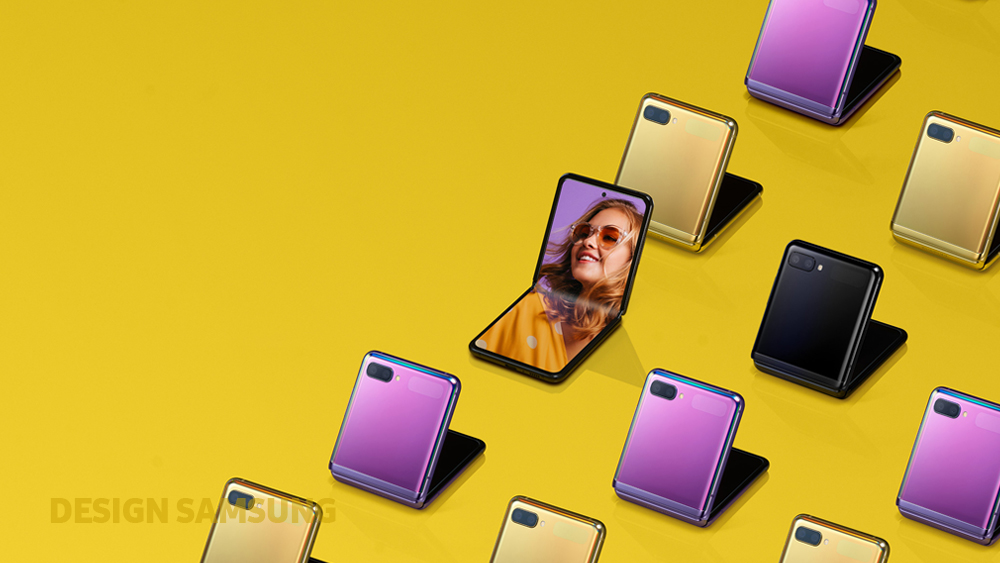
The Galaxy Z Flip is available in a choice of three stylish colors: the bold and creative Mirror Purple, the luxurious Mirror Black, which features a slight bluish tint, and the elegant and refined Mirror Gold. During the manufacturing process, Samsung combined a smooth glass finish with precise processing, resulting in layers of colors that reflect a range of hues depending on the angle at which the device is folded.


For those who like to dress simply, the Galaxy Z Flip can add an eye-catching touch to your outfit that can take your look to the next level. Created for those who want their technology to be as iconic as their wardrobe, the Galaxy Z Flip Thom Browne Edition features a pebble grey exterior adorned with the iconic New York fashion brand’s signature colors.


It’s All in the Details


Measuring just 73.6mm across, the Galaxy Z Flip is small enough to fit in the palm of one’s hand, and slips easily into a pocket or bag. To make the device as compact and portable as possible, Samsung tested out numerous form factors before ultimately landing on the design you see before you. No detail was overlooked. The design was contemplated down to the micrometer to ensure that it would offer users a comfortable grip.


The finished design also reflects careful consideration of usability, as evidenced by convenient features like the cover display. When the Galaxy Z Flip is closed, the cover display presents users with information such as the date, time, their device’s battery status and more, and when they’re taking a selfie, it allows them to see how they look. When the device is opened, Samsung’s intuitive One UI makes it easy to manage the Galaxy Z Flip’s spacious, 6.7-inch display with one hand.


“Along with size and grip, the user experience was a key focus of design,” Kim explained. “We designed the Galaxy Z Flip to make it easy to: 1) access basic information when the device is folded, and 2) multitask on its large display.”


Unfolding a New User Experience


Through extensive research into how consumers are using their smartphones today, Samsung identified that the ability to fold and utilize a smartphone at various angles would add a new layer of convenience to the user experience. The Galaxy Z Flip was specifically designed to be folded and used at multiple angles, which makes everything from taking pictures and video calling, to viewing media more comfortable and convenient.


Realizing that functionality would require a hinge that was both durable and exquisite, like a cogwheel. Through exhaustive research on hinge designs, as well as close cooperation among hardware departments, Samsung eventually came up with a blueprint for a hinge that would be capable of standing a foldable device up at any angle. The Galaxy Z Flip’s intricate Hideaway Hinge is the product of these efforts. It allows users to utilize their device at various angles, and enables the smartphone to stand completely on its own. It’s also sturdy enough to ensure that the device will not open or close by itself.


Samsung anticipates that the Galaxy Z Flip’s ability to stand on its own will change the smartphone experience. “Both the market and consumer lifestyles are constantly diversifying,” said Kim. “To address consumers’ needs, we will continue exploring ways to enrich the Galaxy Z lineup and the foldable mobile category with meaningful and enjoyable experiences.”


* This article was originally published here

Wednesday, February 12, 2020

Samsung’s 108Mp ISOCELL Bright HM1 Delivers Brighter Ultra-High-Res Images with Industry-First Nonacell Technology


Samsung Electronics, a world leader in advanced semiconductor technology, today introduced its next-generation 108-megapixel (Mp) image sensor, Samsung ISOCELL Bright HM1. With a spectrum of light-enhancing technologies spanning from Nonacell and Smart-ISO to real-time HDR, ISOCELL Bright HM1 allows brighter and more detailed 108Mp photographs and crystal-clear 8K videos at 24 frames per second (fps), even under extreme lighting conditions.


“To capture meaningful moments in our lives, Samsung has been driving innovations in pixel and logic technologies that enable ISOCELL image sensors to take astounding photographs even when lighting conditions aren’t ideal,” said Yongin Park, executive vice president of the sensor business at Samsung Electronics. “By adopting Nonacell and Smart-ISO technologies, the 108Mp ISOCELL Bright HM1 helps take vivid high-resolution pictures across a wide range of lighting environments.”


At a 1/1.33” scale with 108-million 0.8μm pixels, the ISOCELL Bright HM1 features the industry’s first state-of-the-art Nonacell technology, which delivers brighter images in low-light settings. In 2017, Samsung introduced Tetracell, a pixel-binning technology with a special two-by-two array that merges four neighboring pixels to work as a single large pixel. Nonacell is an enhanced version of Tetracell with a three-by-three pixel structure. In the HM1, Nonacell merges nine neighboring 0.8μm pixels to mimic a large 2.4μm pixel, more than doubling Tetracell’s light absorption.


As the number of adjoined cells increase, so does color interference, making pixel-binning technologies more challenging, While such difficulties had limited Nonacell to a theory, the HM1 was able to realize the method by adopting Samsung’s ISOCELL Plus technology, which dramatically reduces crosstalk and minimizes optical loss as well as light reflection.


For ultimate results under any lighting condition, the HM1 supplements Nonacell with several other advanced pixel technologies. For example, the HM1’s Smart-ISO technology produces vivid and vibrant images by intelligently selecting the optimal ISO. High ISOs are used in darker settings while low ISOs are better for brighter environments to control light saturation.


In challenging mixed-light environments for photo-taking, the HM1’s real-time HDR technology optimizes exposures, producing more natural looking videos and still photographs. By assigning the most appropriate exposure lengths to each pixel, the HM1 is able to capture scenes in multiple exposures simultaneously, generating HDR images in real-time for both preview and capture modes. For sharper results, the HM1 supports a gyro-based electronic image stabilization (EIS) and Super-PD, an advanced phase detection technology for fast and accurate auto-focus.


The HM1 allows users to preview and capture full shots and close-ups of the subject at up to 3x lossless zoom, preserving the quality of the image. This is made possible by the sensor directly converting the pixels using an embedded hardware IP, rather than having the task delegated to the mobile processor. With 108-million pixels, the sensor is also able to produce images up to 3x zoom at a 12Mp resolution without upscaling.


Samsung ISOCELL Bright HM1 is currently in mass production.


* Samsung first announced its ISOCELL technology in 2013, which reduces color crosstalk between pixels by placing a physical barrier, allowing small-sized pixels to achieve higher color fidelity. Based on this technology, Samsung introduced the industry’s first 1.0um-pixel image sensor in 2015 and a 0.9-pixel sensor in 2017. In June 2018, Samsung introduced an upgraded pixel isolation technology, the ISOCELL Plus.


* This article was originally published here

Sunday, February 9, 2020

[Editorial] Dawn of a New Decade of Galaxy

Unpacked is my favorite time of year. It’s here that we set the tone for the mobile industry and we open people’s eyes to new possibilities for the future. This year is especially meaningful to me because it’s my first year at Unpacked as Head of Samsung’s Mobile Communications Business.


Over my career at Samsung, I’ve had the pleasure of leading the development of mobile devices with breakthroughs that have come to define the last decade of smartphone innovation, starting with the very first Galaxy S and more recently, the Galaxy Fold. Today, I’m excited to say that we believe we are at the dawn of an inspiring new decade filled with the promise of growth and change. The growth and change for the smartphone industry, and ecosystem as a whole. As a leading player within the mobile industry, we relish our responsibility to lead next decade, empowered by experience innovation, cutting-edge technologies, and most of all, compelling products.


Fifty years ago, Samsung Electronics was founded with a clear purpose: to use the power of technology to create a better world. Driven by our commitment to break down barriers and make what some thought impossible, possible.


In 2011, we recognized that consumers were doing even more on their devices. We responded and introduced a more powerful phone with a larger screen and an S Pen to give consumers ultimate productivity on the go—the Galaxy Note. With every new device, we continued to innovate and pioneer new display, camera, and performance technologies. Last year, we created a new category with a foldable device, the Galaxy Fold.


Now, here at the start of 2020, we are excited about the opportunity to define a new era. An era that is defined not simply for innovation’s sake but to truly enable experiences that are more personal, meaningful, private and secure; that will create more intelligent connections across devices, people, businesses, and communities. This will be enabled by key advancements in the three most important technologies of our time: 5G, AI and the Internet of Things (IoT). As the leading innovator of new mobile experiences, Samsung is proud to drive the convergence of these technologies across various smart devices, including Galaxy phones, wearables and PCs.


We’ve already started bringing these new experiences to life. Through open collaboration with industry leaders, such as Google and Microsoft, we are building the robust connected ecosystem in the world. And we are working with major carriers to expand 5G services, so hundreds of millions more consumers around the world can have access to next generation networks.


It’s our responsibility and opportunity to shape the next ten years of mobile innovation, starting right now at Unpacked. No company is better suited to take on this massive challenge than Samsung.


What an exciting time for Samsung, our industry and consumers.


You will see some exciting examples of how we’re driving progress, changing the shape of the future and introducing new mobile experiences at Unpacked. I’m excited to flip the industry on its head. It’s going to be an absolutely incredible event, and I hope you’ll join me—online or in-person—for Galaxy Unpacked 2020 on Tuesday, February 11th.


* This article was originally published here

Saturday, February 8, 2020

Samsung Electronics Announces Fourth Quarter and FY 2019 Results

Samsung Electronics today reported financial results for the fourth quarter ended December 31, 2019 and the fiscal year 2019. The Company posted KRW 59.88 trillion in consolidated quarterly revenue and KRW 7.16 trillion in quarterly operating profit.


For 2019, Samsung reported KRW 230.40 trillion in revenue and KRW 27.77 trillion in operating profit.


Fourth quarter profit dropped from a year earlier due to the continued fall in memory chip prices and weakness in display panels. Improving demand for memory used in servers and mobile products, as well as solid sales of flagship smartphones, helped ease the decline in overall earnings.


The Memory Business reported a year-on-year decline in profit as DRAM prices continued its downward trend despite rising shipments. However, earnings increased from the previous quarter, underpinned by increasing demand from data centers and other major applications as well as cost reduction. The logic chip business posted a YoY profit growth on demand for high-resolution image sensors and HPC (high performance computing) chips.


The Display Panel Business suffered weak demand for some premium mobile screens and saw widened losses from the large panel business.


Quarterly earnings improved significantly for the Mobile Business in annual terms, thanks to solid sales of flagship Galaxy smartphones and lineup changes to improve profitability for mass-market models. Profit fell from the previous quarter, however, due to the fading effect from a new flagship product launch.


The Consumer Electronics Business also reported a YoY increase in earnings, led by growing sales of premium products including QLED TVs and new appliance offerings.


In the first quarter of 2020, the Company expects weak sales from seasonality in memory chips, OLED and consumer electronics.


The seasonal effects will likely limit profits in the Memory Business while the outlook is also negative for the Display Panel Business due to slowing demand.


First quarter profit from the Mobile Business is seen steady quarter-on-quarter, as new flagship and foldable models will improve sales but incur additional marketing costs.


Looking ahead to 2020, Samsung expects improvements in overall business performance but also sees continued uncertainties in the global business environment.


Memory market conditions will likely improve gradually thanks to increasing demand from data center companies and 5G smartphone adoption. However, the actual pace of 5G expansion and its effects on DRAM content remain to be seen. The Company expects inventory to return to levels seen in previous years within the first half of this year and will focus on transitioning to the next-generation chip production; 1Z-nm DRAM process and 6th-generation V-NAND.


The System LSI Business will offer differentiated 5G System-on-Chip products and high-resolution sensors. The Foundry Business plans to expand production from the 5nm and 7nm EUV (extreme ultraviolet lithography) processes while working on developing next-generation 3nm GAA (gate-all-around) technology. In Displays, Samsung will prioritize on responding to growing adoption of OLED and folding screens.


The Mobile Business aims to improve profits by expanding sales of premium models, such as the enhanced 5G lineup and new foldable devices. The Network Business will focus on addressing the global 5G market as its Korean business is set to shrink following last year’s nationwide 5G adoption.


In the Consumer Electronics Division, the Company will seek to increase sales of QLED 8K TVs and launch new premium appliances such as Bespoke and new lifestyle models.


Samsung Electronics’ capital expenditure in 2019 totaled at KRW 26.9 trillion, including KRW 22.6 trillion spent on semiconductors and KRW 2.2 trillion on displays. In 2020, the Company will be flexible in capex execution to meet changing demand from markets, while continuing investment in infrastructure and mid- to long- term business opportunities.


Weakness Looms After Semiconductor Demand Rises in Fourth Quarter

The Semiconductor businesses posted KRW 16.79 trillion in consolidated revenue and KRW 3.45 trillion in operating profit in the fourth quarter.


The Memory Business saw solid market demand in the fourth quarter, led by growing demand from server customers. Demand for major applications like those related to 5G network expansions also contributed to gains. On a quarterly basis, earnings improved on cost reduction from process migration and increased sales of differentiated products.


The Company also exceeded its shipment volume guidance for the fourth quarter on proactive responses to demand for all applications.


In the case of DRAM, server demand increased primarily centered on high-density products as datacenters, as well as customers in China boosted orders as a result of new CPU adoption. For mobile, the growing sophistication of mid-to-high end smartphones drove up content per handset in addition to positives linked to 5G network expansions. For PC, negative issues like a CPU shortage were offset by an increase in set-builds at OEM customers, keeping purchasing demand solid.


For NAND, demand was higher than expected thanks to new smartphone launches generating orders for high density models. Increased demand for SSD from server applications also helped performance.


In the first quarter of 2020, overall DRAM demand is seen softening on seasonal effects, although some purchases for mobile and server applications will remain relatively solid. The Company aims to reinforce its cost competitiveness by expanding node migration to 1Y-nm-scale products and utilizing its flexible product mix to respond to demand for high density products.


Also in the January-March period, NAND prices are expected to keep rising mainly on server demand as the market stabilizes. To boost profitability and competitiveness, the Company plans to accelerate the migration process to 6th generation V-NAND in the first half of 2020.


In 2020 on a whole, server demand for DRAM is seen solid on the back of increased investments by data centers. For mobile, the pace of 5G expansion and its effects should be monitored closely but the Company sees demand picking up around mass-market models as major manufacturers expand their 5G smartphone lineups. Construction of 5G networks in China will also drive demand for consumer products this year.


In the case of NAND, server SSD demand from data centers is expected to continue growing this year while the expansion of 5G networks may reinforce the high-density memory demand for mobile devices. The Company also expects new demand from applications such as gaming and automotive.


Meanwhile, earnings for the System LSI Business declined on-quarter as the peak season for mobile handsets faded. In the first quarter of 2020, the Company plans to maximize shipments of major components like APs, image sensors and DDIs adopted by Samsung’s major customers for new flagship smartphones.


In 2020, the System LSI Business plans to expand its 5G chip business by promoting one-chip solutions for mass-market devices. Demand for image sensors is seen rising in 2020 on intensifying competition for better camera specs.


Lastly, the Foundry business saw solid results in the fourth quarter on 5G chips and high-resolution image sensors. Earnings were also helped by demand for HPC chips from Chinese customers. This year, revenue growth is expected to climb and reach double-digits on mass production of 8nm computing chips and demand for 5G related chips.


In 2020, the Company plans on completing the product design for the 4nm process and a number of 5nm-based product designs in order to diversify its customer base and expand applications using Samsung products.


As Earnings Suffer, Display Business to Focus on Securing Profitability

The Display Panel Business posted KRW 8.05 trillion in consolidated revenue and KRW 0.22 trillion in operating profit for the fourth quarter. Overall display earnings decreased QoQ due to weak performance across the business.


Mobile display earnings saw profit decline because of a higher cost burden caused by lower fab utilization amid weaker demand for some premium products. Large displays suffered a bigger loss from a continued decline in LCD panel prices.


Looking ahead to the first quarter of 2020, Samsung expects a further drop in mobile displays earnings due to weak demand from some customers. The Company will strive to enhance profitability by offering more panels with distinct designs, expanding its IT product customer base and strengthening price competitiveness.


Large displays are likely to stay in the red owing to stagnant sales amid weak seasonal effects.


In 2020, for the mobile display business, demand for OLED screens is forecast to grow with wider adoption of 5G smartphones despite intensified competition. The Company will make efforts to expand sales and boost utilization with a broader customer base and stronger product competitiveness. Especially, Samsung will seek to actively address demand for new applications such as foldable devices and other IT products.


For large displays, weak earnings are likely to continue this year as panel oversupply persists and conversion efforts for next-generation QD-Display production incur costs. The Company will focus on securing profitability by expanding sales of value-added products such as ultra-large and 8K TV panels and premium monitor panels.


Mobile To Focus On New Flagship and Foldable Models

The IT & Mobile Communications Division (IM) posted KRW 24.95 trillion in consolidated revenue and KRW 2.52 trillion in operating profit for the fourth quarter of 2019.


While overall demand for smartphones and tablets increased QoQ as a result of year-end seasonality, revenue for the Mobile Business decreased QoQ as the effect from new flagship model launches faded. However, the profit drop was capped by effective use of marketing expenses for the holiday season and as the profitability of major smartphones including the Galaxy A series held steady.


Looking ahead to the first quarter, weak demand is seen for smartphones and tablets due to low seasonal demand. In these circumstances, Samsung expects smartphone revenue to rise on improved product mix with the launch of new flagship models and foldable smartphones. However, operating profits are expected to remain flat due to higher marketing expenses used to boost flagship smartphone sales.


For the whole of 2020, while demand for 5G smartphones is expected to increase, market competition is also forecast to intensify as manufacturers increasingly adopt high performance components including APs, memory and cameras. In response, the Company plans to differentiate its premium smartphones by expanding 5G adoption and introducing new designs for foldable products.


Furthermore, Samsung will expand its 5G product portfolio and strengthen product competitiveness of mass-market smartphones by quickly adopting innovative technology based on market needs. With these efforts, the Company aims to improve earnings YoY by expanding sales of premium smartphones and enhancing the competitiveness of its mid- to low-end lineup.


As for the Network Business, while total revenue in the fourth quarter decreased QoQ as 5G network adoption in South Korea was concentrated in the first half, 5G revenue increased in overseas markets, including the United States and Japan. For 2020, although 5G business in the domestic market is expected to decline YoY, Samsung will expand 5G network solutions in overseas markets by solidifying its core competencies and increasing cooperation with major business partners.


Premium TVs and Appliances Shine in Fourth Quarter; Risks Mixed Ahead

The Consumer Electronics Division, comprised of the Visual Display and Digital Appliances businesses, recorded KRW 12.71 trillion in consolidated revenue and KRW 0.81 trillion in operating profit for the fourth quarter of 2019.


In the fourth quarter, earnings for the Visual Display Business improved both QoQ and YoY on the back of successful promotion efforts during the year-end peak season. Sales of QLED TVs and TVs with 75-inches-and-above screens were especially notable, showcasing an improved product mix for the Company.


In particular, QLED TV sales in the fourth quarter exceeded twice the amount sold in the same period a year ago.


However, the Company forecasts market demand in the first quarter to decline QoQ following the year-end peak season, and also YoY due to weaker demand in developed markets.


In 2020 on a whole, the global TV market faces geopolitical risks, but global TV demand is expected to climb thanks to sports events like the UEFA European Football Championship and the Summer Olympic Games.


For the Digital Appliance Business in the fourth quarter, earnings rose on increased demand in emerging markets including India. Revenue and profit both improved YoY as sales of premium products like the Bespoke refrigerator and large dryers grew.


Samsung plans to continue launching new lifestyle digital appliances and premium products to seek growth in the first quarter. For the whole year, the Company sees uncertainties from global economic sluggishness but will aim to offset risks through the expansion of its premium lineup and more B2B opportunities.


※ Consolidated Sales and Operating Profit by Segment based on K-IFRS (2017~2019)


Note 1: Sales for each business include intersegment sales

Note 2: CE (Consumer Electronics), IM (IT & Mobile Communications), DS (Device Solutions), DP (Display Panel)

Note 3: Information on annual earnings is stated according to the business divisions as of 2019


* This article was originally published here

Wednesday, February 5, 2020

Take a Moment to Relax with Galaxy’s New, Nature-Inspired ‘Over the Horizon 2020’


In our increasingly plugged-in world, it can be easy to forget to take a moment every now and then to stop and smell the roses. Inspired by the simplicity of time spent outdoors and the calming sounds of nature, Samsung’s latest “Over the Horizon” remix is a fully acoustic version of the company’s signature sound designed to help bring you closer to the beauty of the world around us.
 

With each new generation of Galaxy devices comes a fresh new take on the “Over the Horizon” theme, and at the core of this year’s version is the power of nature itself. In order to capture the harmonious working of the natural world in all its glory, Samsung placed monochords in various natural locations in order to harness the power of nature for music.


Powered by the natural force of running water, the monochords operate thanks to a rotor- and pulley-based mechanism. As the mechanism rotates, it triggers the monochords to pluck their respective strings in the correct order. The resulting musical refrain has the unique characteristic of having been played solely by the force of nature.


On top of the monochord melody, Samsung also emphasized sounds like running water and chirping birds and kept the use of electronic elements to a minimum in order to help maximize the listener’s connection with the relaxing sounds of nature.


To complement the soothing, back-to-nature vibe of this remix, Samsung produced an accompanying video made up of relaxing footage of the natural world in all its glory. From calm woodland groves to awe-inspiring coastal vistas, the video showcases the true beauty of nature as well as the force of it in action as it powers the monochords. Check out the latest remix of “Over the Horizon” along with its tranquil music video above.


* This article was originally published here